

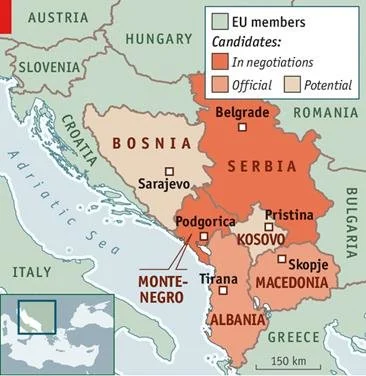
Selim Ibraimi – Disputes and misunderstandings are not ending in the Western Balkans. Media in the region have reported that Croatia has now set some conditions for Montenegro. Official Zagreb is ready to block Montenegro in the final steps towards EU membership, scheduled for 2028. According to Croatia, some commitments by Podgorica must be fulfilled to continue the path towards the EU.
The Montenegrin daily, “Vijesti”, has announced that the Croatian government has presented the Montenegrin government with a document containing a list of ten points that must be resolved before Montenegro can join the EU. Some of the conditions are: war reparations, missing persons, war crimes, property disputes, bilateral and maritime borders, open historical problems with Montenegro, etc. The Croatian government has stressed that it supports Podgorica’s EU aspirations, but Zagreb expects concrete actions to improve neighborly relations based on the requests sent to the Montenegrin government.
According to analysts, Montenegrin Prime Minister Milojko Spajic and the ruling coalition are managing the new dispute through diplomacy. Montenegro relies on the European Commission’s previous opinions on the country’s progress, and is also responding to the situation with a new rhetoric for domestic consumption. According to Podgorica, bilateral issues should be resolved through open dialogue, not by blocking the path to the EU.
Recent developments show that the integration of the Balkans into the EU is a major problem for Brussels and regional governments. Is this the right way for governments to misuse history to prevent other countries from joining? Of course not. The current mess is well known in Brussels. From the latest developments, Albania also hopes to start the process in 2027, but it is not certain how Greece will act further.
Due to the desire to block each other, the enlargement is being questioned. In this line, the television network “Euronews” has reported that the European Commission has lost the dynamics of the enlargement. In fact, the EU has done a lot for the region, despite the criticism. It remains for the Balkan states themselves, with external help, to overcome the disagreements. In this group of interstate disagreements, we should not forget that North Macedonia and Bulgaria have not moved from their strong points.
Serbia and Kosovo are in the same bilateral relations or even worse.
The last Croatian obstacle is not so easy to solve, despite the statements of the Montenegrin government. Montenegro is likely to cause new problems for Brussels and at the same time embarrass the European Commission. Montenegro has been a candidate for EU membership since 2010, and has been faced with strong Serbian-Russian influence. Croatia became an EU member in 2013; the rest of the Western Balkans, except for Podgorica and Tirana, are still weighing whether to join the EU.
The article was written specifically for Portalb.mk. The publication rights are only owned by Portalb.mk and the author, according to the agreement between them.
- Ibraimi holds a PhD in Political Science from SEEU, an MA in International Relations from Webster University in the U.S., and a BA in Journalism from the State University of Tirana in Albania.