
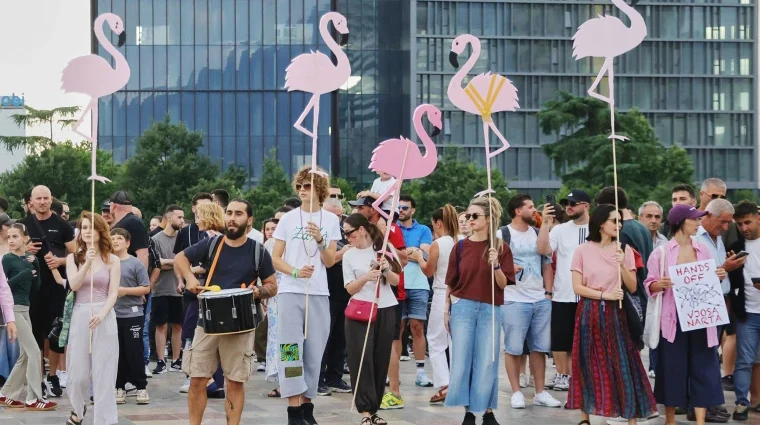
From Besnik Rama- When citizens protest corruption and the rising cost of living, the response of those in power reveals much about the state of democracy. Albania’s Prime Minister is facing growing public anger over allegations of corruption and the rising cost of living. Instead of addressing the protesters’ concerns, critics accuse his government and political allies of using a series of tactics to discredit the movement, intimidate demonstrators and weaken public support.
The allegations are serious. They describe a pattern in which protesters are portrayed as foreign agents, peaceful demonstrators are associated with violence, individuals are publicly exposed, economic and professional consequences are threatened, and force is used against demonstrators and members of the media.
These allegations are also part of the newly presented „anti violence legal package“ from the prime minister whereby he aims at prosecuting and/or applying high fines on those who participate in „violent“ protestest, its a further escalation of the government‘s unlawful acts against its citizens. This approach is clearly in breach of the provisions of the constitution and the right to protest.
If substantiated, these practices would raise serious concerns about democratic accountability, freedom of expression and the right to peaceful protest.
Here are five tactics identified in the account of the protests.
- Blaming a “foreign hand” instead of answering protesters
When citizens demand answers about corruption and living costs, their concerns deserve a direct response. Yet, according to the account provided, the Prime Minister and his allies have instead pointed towards alleged foreign involvement, naming Greece, Iran, Russia and Antifa.
A photograph of a “Greek bus” was reportedly presented on television as evidence of outside interference. The account claims that the image was generated using ChatGPT. Police, meanwhile, allegedly failed to provide evidence establishing the involvement of foreign organisations.
Claims of foreign interference should be supported by credible evidence, not speculation or misleading imagery. Without substantiation, such accusations risk diverting attention from the protesters’ demands and encouraging the public to view legitimate political dissent as a threat orchestrated from abroad.
Citizens asking questions about their own government should not have their concerns dismissed simply because their demands are uncomfortable for those in power.
- Denying the legitimacy of genuine protesters
Another alleged tactic is to undermine the credibility of an entire protest movement by associating peaceful demonstrators with a small number of people accused of violence.
According to the account, after some individuals threw stones, the Prime Minister declared that anyone who remained near them was “with them.”
Such a statement raises an important question: should the actions of a few individuals determine how an entire crowd is judged?
Violence should be investigated, and those responsible should be held accountable through fair legal procedures. However, peaceful protesters should not automatically be treated as accomplices simply because they were present at the same demonstration.
The distinction matters. The right to peaceful assembly is a fundamental democratic freedom. When peaceful participants are collectively associated with violence, the result can be to discourage ordinary citizens from exercising that right.
A government committed to democracy should distinguish between individual wrongdoing and peaceful political opposition.
- Publicly exposing and discrediting individuals
The account also alleges that the faces and purported criminal records of 45 people were displayed on television, accompanied by the warning: “No one will remain unexposed.”
The circumstances surrounding these broadcasts, the accuracy of the information presented and the legal basis for disclosing it require independent verification.
According to the information provided, one individual described as “not a student” was, in fact, a medical student. Another person reportedly presented a certificate stating that they had not been convicted of a crime.
These examples, if accurately reported, raise questions about the consequences of publicly labelling individuals before their circumstances have been properly established.
Public accusations can damage reputations, expose people to harassment and discourage others from participating in demonstrations. When allegations are presented through powerful media platforms without transparent supporting evidence, those targeted may have little opportunity to defend themselves.
Accountability must apply to everyone, including those in government. Public exposure should not become a substitute for evidence, due process or the presumption of innocence.
- Using economic and professional pressure to create fear
The fourth alleged tactic involves the use of economic opportunities and access to public services as instruments of pressure.
The account claims that protesters have faced threats involving the withdrawal of scholarships, the denial of state services to family members, and restrictions on teachers seeking or retaining public employment. It also describes plans for a register of people labelled “violent.”
These allegations require careful investigation. If public benefits, employment opportunities or essential services are withheld because of peaceful political participation, that would raise serious concerns about discrimination and the misuse of state power.
Students should be able to pursue their education without fearing punishment for their political views. Teachers and other public employees should not have to choose between their livelihoods and their right to express themselves peacefully.
Likewise, family members should not be penalised for another person’s political activity.
A state register of people accused of violence would also require clear legal safeguards, reliable evidence, transparent procedures and an effective right to challenge incorrect information. Otherwise, there is a risk that such a system could be used to stigmatise political opponents rather than address genuine criminal conduct.
Democracy depends on citizens being able to participate in public life without fear of losing their education, employment or access to essential services.
- Resorting to force while placing pressure on the press
The fifth set of allegations concerns police conduct, the treatment of detained protesters and attacks on journalists and other media workers. According to the account provided, minors detained during the protests alleged that they had been abused in custody. At least 12 media workers were reportedly attacked, most allegedly by police.
These claims should be independently investigated, with particular attention to the safety of detained minors, the conduct of law enforcement officers and the ability of journalists to report freely.
Police have a responsibility to protect public safety and respond lawfully to violence. That responsibility does not remove their obligation to respect human rights, use proportionate force and ensure the humane treatment of anyone in custody.
The account also states that police officers received a one-off bonus reportedly equivalent to approximately three months of pay. The timing, amount and circumstances of that payment would need to be confirmed before any connection with the protests could be established.
The treatment of journalists is equally important. A free press enables the public to scrutinise the conduct of governments, police and protesters alike. Attacks on media workers threaten not only the individuals involved but also the public’s ability to obtain reliable information.
When allegations of police abuse and attacks on journalists are not transparently investigated, public confidence in state institutions can suffer.
Dialogue cannot replace accountability
The account states that the Prime Minister subsequently offered dialogue while the threat of publicly exposing protesters allegedly remained in place. Dialogue can be an important step towards resolving political disputes. However, meaningful dialogue requires more than an invitation to talk. It requires a willingness to listen, acknowledge legitimate concerns and protect the rights of those taking part.
If demonstrators believe that participation could expose them to public humiliation, professional consequences or other forms of retaliation, they may reasonably question whether the invitation is genuine.
A credible process would require transparency, safeguards against retaliation and a commitment to investigating allegations of misconduct, regardless of who is implicated.
The government has a responsibility to address the underlying concerns that brought people onto the streets. Those concerns cannot be resolved simply by questioning the protesters’ motives or demanding that they stop demonstrating.
Why these allegations matter for democracy
Taken together, the five alleged tactics point to a wider concern: the possibility that political dissent is being treated as a threat to be neutralised rather than a legitimate part of democratic life.
Blaming foreign actors can distract from domestic grievances. Associating peaceful demonstrators with violence can undermine their legitimacy. Publicly exposing individuals can intimidate others. Threats involving education, employment and public services can discourage participation. The use of excessive force and pressure on journalists can restrict the public’s ability to speak and obtain information.
However, each allegation must be assessed on its own evidence. Establishing whether a government is deliberately pursuing such a strategy requires reliable documentation, independent investigation and an opportunity for those accused to respond.
The principles at stake remain clear: peaceful assembly, freedom of expression, press freedom, equal treatment under the law and protection from arbitrary punishment are essential to a functioning democracy.
The protesters are citizens, not enemies
At the heart of these demonstrations are citizens who, according to the account presented, want a better future and are demanding answers about corruption and the cost of living.
Their concerns deserve to be heard. Their allegations deserve to be examined. Their rights deserve to be protected.
That does not mean every claim made by a protester must automatically be accepted, nor does it excuse violence by any individual. It means that the same standards of evidence, fairness and accountability must apply to protesters, public officials and law enforcement alike.
A government should not fear scrutiny. It should welcome the opportunity to demonstrate that its decisions are lawful, its institutions are accountable and its citizens can express disagreement without intimidation.
Conclusion: Do not turn away
Authoritarian practices do not necessarily emerge all at once. Democratic freedoms can be weakened gradually when dissent is discredited, individuals are intimidated, the press is restricted and accountability becomes increasingly difficult to obtain.
The allegations surrounding Albania’s protests deserve serious, independent scrutiny. If substantiated, they would demand answers from the institutions responsible and meaningful safeguards for the rights of citizens.
The international community, independent journalists, civil society organisations and human rights institutions all have a role in ensuring that credible allegations are investigated and that fundamental freedoms are respected.
Silence does not establish the truth, and outrage alone does not establish the facts. What is needed is evidence, transparency, accountability and solidarity with the right of people to demand better from those who govern them.
The protesters are not automatically enemies of the state because they challenge its leaders. They are citizens exercising a right that democracy is meant to protect. Do not look away. Do not dismiss their concerns. Do not remain silent when democratic freedoms are at risk.
NOTE: The editorial team of ISSD Macedonia does not always agree with the views expressed by external authors. In the interest of openness and the functioning of independent media, ISSD Macedonia publishes articles in support of the principle of a free press, based on established standards.